skip to main |
skip to sidebar
After leaving Chicken, we continue on 94 miles to our real destination of Eagle.
Two hundred air miles northeast of Fairbanks-
-the road ends at a grass air strip-
-along the Yukon River and Calico Bluff.
The town of Eagle is a glimpse into the past as well as a window into todays unique northern lifestyle.
The road closes in winter and snow isolates this community for six months of the year.
This 1880 trading post became the commercial, military and judicial center for the upper Yukon.
A close look at this roof reveals a nice caribou head and some well used and still very functional Blazo gas cans.
Today it retains much of it's original frontier atmosphere and charm.
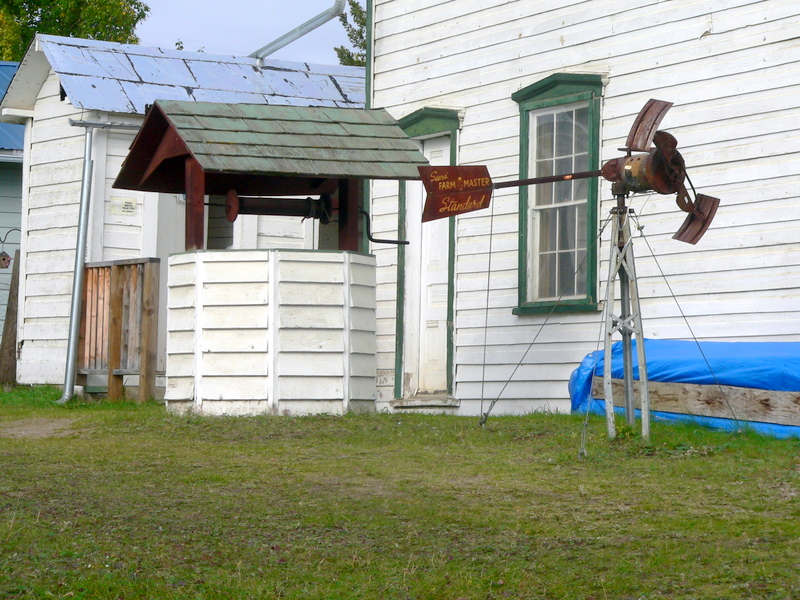
The original wellhouse, hand-dug in 1903, still provides water for over 1/2 the towns population of two hundred.
In rural Alaska, getting water for drinking and household use is often a huge problem. In more remote areas, householders sometimes melt snow, or use small creeks. Even on the road system, the cost of drilling a well can be prohibitive-or local water may not be fit for drinking. Many rural Alaskans have large indoor plastic water tanks that can be kept warm. In Eagle, people drive to this wellhouse and fill their jugs, water tanks or barrels. The hose and nozzle are originally from a gas pump.
You really, really don't want to have a fire here. This is the real thing and your cabin most likely would burn to the ground before adequate water could be applied.
Eagle is one of the best preserved boom towns commemorating the mining era in Alaska.
Most of the buildings are original log cabins, which gives a feeling of the town as it must have appeared during the gold rush era.
By 1898 it had a population of 1,700 living in more than 500 cabins and tents.
Yes, you can own your very own authentic miners cabin! This one has several rooms and is on two lots. Right in town, it is really an unusually rare find as very few are ever for sale. No, we did not buy it, but if we were younger we would think about it.
With some regrets, we leave Eagle and head toward the Canadian border, as winter is coming and we need to keep going.
Back at the Moose Lodge in Fairbanks we enjoy happy hour with our Escapee friends George and Betty Bryant, Don Hankins and Karen Sweeney as we compare experiences of the trip we have all just completed.
Our rig needed a good wash job to remove the corrosive calcium chloride encrusted mud that was firmly attached to it.
It was up to 1/2 inch thick on some places and several inches thick underneath.
We celebrated with dinner at the Northern-most Dennys in the world.
Leaving Fairbanks for the last time, we headed Southwest 14 miles and passed through North Pole, Alaska, home of Santa Claus.
As one might expect, Santaland isn't much more than a tourist trap gift shop.
At Delta Junction we come to the Northern end of the Alaska Highway-
-and head north on the Taylor Highway to Chicken.
The 160 mile road is 2/3 gravel and somewhat treacherous -
-but it's a piece of cake after the Dalton Highway to Prudhoe Bay.
We see brilliant displays of pink fireweed , common along roads in the north. It flourishes in burn areas where it can grow to six feet tall. When it blooms in late June, the lowest flowers on the stem bloom first. As summer passes, it begins losing flowers from the top of the stem down.
Fall colors are everywhere now even though it is still late August. Winter comes early in the North, and it is begining to show.
We pass an old gold mining camp-
-and have a clear view of a fireline backfired during the 2004 fires.
We arrive at Chicken, once a gold mining town, but now only three reconstructed commercial buildings set up as yet another tourist trap.
This is not the Alaska we came to see and once again we are thankful for the way we travel to the more remote areas in our camper.