Friday, June 17, 2011

Port Medway Park, Bridgewater Carding Mill, Lunenburg


 Our camp last night was in Port Medway and we woke up this morning to a beautiful sunrise.

 We had a delightful evening on this patio area talking with two other traveling couples, one from Virginia and the other from Australia.

We will spend the next week or so traveling with Ron and Betty Robinson from Sydney.  They have RV’d extensively in Europe, purchased an RV in Arizona and traveled much of the U.S., and are now traveling in Canada.

We came upon the Wile Carding Mill in the town of Bridgewater and had a nice tour.

 Betty’s brother has a sheep ranch in Australia and both she and Judy like to knit so this was a nice place to visit.

                                     They had fun carding and spinning some wool--

 --and were quite surprised when they were told they were hired at a starting wage of $3 a week!

The next stop was the town of Lunenburg, a UNESCO World Heritage site.


We spent much of our time at the Fisheries Museum of the Atlantic.  This three story building is full of many types of exhibits, tracing the history of fishing on the Grand Banks off Newfoundland from the 1500’s to the present.

 Exhibits covered everything from marine engines, whaling, boat  building, types of fishing vessels and methods, rum running, life in fishing communities, and model ship building.  Several boats in the harbor were open for us to explore.


 Ron and Betty have a large sail boat in Australia and have lived on it for six years, so this was an interesting day for them.


Tuesday, June 14, 2011

Port Royal


                  Port Royal is not a fort but a small French compound begun in 1605.

It was the home of one of the earliest European settlements on this continent.

 The French and local native people, the Mi’kmaq, formed a friendship and traded here.

                                   It is well restored and our guide was excellent.

 She told of her Mi’kmaq heritage and stories her grandfather had related to her.  She remembered him tarring a bark canoe.


The habitation survived until an attack by the British in 1613, when it was looted and burned.
 

Monday, June 13, 2011

Fort Anne


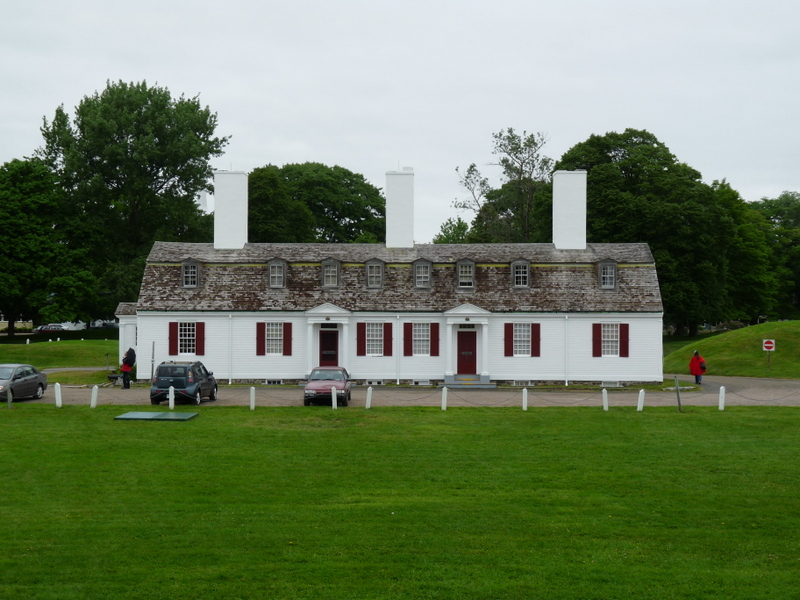
 Designated in 1917, Fort Anne is the oldest national historic site in Canada.

 It was Canada’s most attacked fort during the struggle for empire between England and France in the 17th and 18th centuries.


Using our Canada national parks pass, we entered free today without a single shot being fired.


                                The cannons bear the seal of the Crown of England.


                                            It’s definitely lobster season here!

Sunday, June 12, 2011

Grand Pre


Founded in the early 1680’s by young couples from Port Royal, Grand Pre became the bread basket of Acadie.
The Acadian people were caught between the often warring French and English, who both were trying to claim this important area.

The Acadians developed a means of draining the salt marshes along this coast and turned them into what is still one of the best fertile farming areas in North America.  The dykes they made prevented salt water from entering the marshes.  In a community effort, they created several thousand acres of fertile farmland.

This is part of an actual dyke used by the Acadians.  Rainwater falling on the marshes washed out the salt into man-made ditches where it flowed out one-way valves into the sea.  The “flapper” in the foreground is a one-way “valve” that prevented sea water from returning to the marshes. 

Even though they wished to remain neutral, in 1755 the British began to deport all Acadians to other parts of the world.  Their houses were burned, their livestock seized and their crops destroyed.  Everything they had, except a few personal belongings, was forfeited to the British Crown.

Grand Pre was one of the largest Acadian settlements before the deportation.  Most of these people never saw their homeland again.  In 1764, they were permitted to return.  Those few who did found their former farms occupied by New England Planters and were not permitted to reclaim their land.

In 1847 Henry Wadsworth Longfellow wrote the poem Evangeline about the deportation.

 We encountered this sad story many times in  our travels in Nova Scotia.

 This cross is believed to be near the actual site of the deportation.  Altogether more than 6,000 Acadians were deported from Nova Scotia, separating many families and scattering them forever.